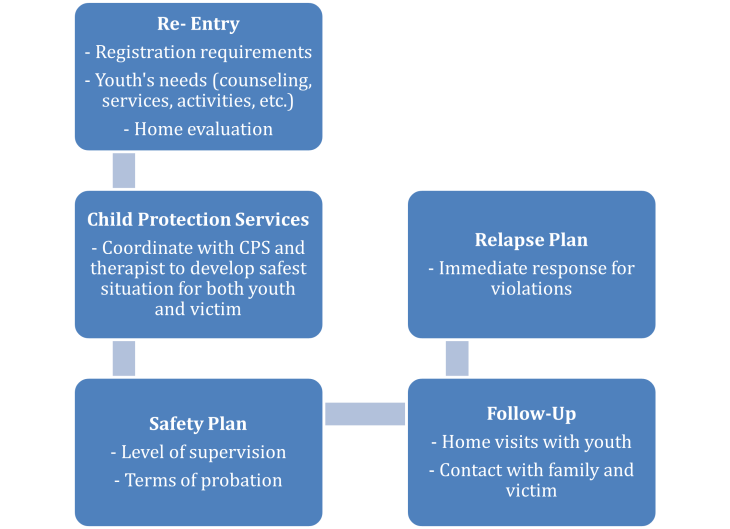
Please note, this document is not a policy or procedure, but simply a reference to assist states when dealing with this type of case and cannot be used as a reason to reject a case.
In many cases, youth adjudicated for sex offenses must be accepted into the receiving state per Rule 4-104 (4): “Supervision shall be accepted unless the home evaluation reveals that the proposed residence is unsuitable or that the juvenile is not in substantial compliance with the terms and conditions of supervision required by the sending or receiving state,” and per Rule 4-104(5), “Supervision shall be accepted when a juvenile has no legal guardian remaining in the sending state and the juvenile does have a legal guardian residing in the receiving state.”
Furthermore, if the receiving state cannot supervise any condition required by the sending state, the receiving state must notify the sending state by documenting which conditions cannot be provided on the Form VIII, Home Evaluation Report (Rule 4-104(6)). This notification is especially critical when the condition involves protecting the safety of the youth, the victim, or potential victims—such as when a youth has been adjudicated for a sex offense and requires a safety plan. In these cases, the receiving state must clearly communicate any inability to supervise safety-related conditions.
Occasionally, a youth is relocated in the home with the victim of his/her offense. As there is no ICJ rule to specifically address this issue, we sought feedback from several states (Connecticut, Florida, Nebraska and Idaho) to outline possible steps states can take when dealing with this type of difficult case.
It is recommended to first search alternative living arrangements for the youth; this includes relatives, foster homes, schools, etc. All measures should be taken to prevent the victim’s removal from the home, as this may further traumatize the victim. Special consideration should also be taken if a restraining order is placed between the victim and the youth.
Pre-Return
Many things should be considered when the victim and the youth will reside in the same home. First, are there legal barriers? Is there a current restraining order between the victim and the youth? Is there some other court order preventing proximity between the victim and youth? If yes, another option must be pursued.
Work with the appropriate individuals in your state by doing the following:
Contact Child Protection Services (CPS) for documentation, safety assessment, etc.
Make contact with the youth’s current supervisor (i.e. out-of-state treatment facility) and begin developing a re-entry plan. The re-entry plan should address the recommended care of the youth (counseling, medication, etc.) and preparedness of the victim and family (training, counseling, etc.).
Contact your child welfare agency to establish a safety plan.
During the home study, consider the ages of siblings, availability of adult supervision, sleeping arrangements, etc. You may also want to consider checking with the victim’s therapist to determine the suitability of the residence.
Determine the level of supervision required based on evaluations by youth’s counselors, degree of offense, etc. and if that level of supervision can be met.
Devise a support plan for the youth, including workgroups, counseling, etc.
Create a follow-up plan to be used after the youth is integrated into the home to ensure all conditions are met. This could include monthly home visits, frequent communication with the victim or the victim’s therapist, etc.
Develop a relapse plan to include immediate response if the youth violates any rules of his/her release.
Post-Return
After the youth is relocated in the home, the case manager, along with CPS, can commence with the decided plans of action to ensure the success of the relocation.
Case workers should conduct home visits according to the plans agreed upon and as specified through ICJ and CPS, etc.
The case manager should maintain contact with the family and victim.
If the youth violates the terms of his/her release, enact the Relapse Plan.
The Victim
To ensure the victim’s safety:
Identify who is providing services to the victim, to determine the status of the victim’s recovery and/or treatment progress.
If not already provided, offer counseling services to the victim prior to the youth’s arrival. The victim should receive sufficient counseling before the youth moves into the home.
The Youth
The youth should be evaluated prior to return and strictly monitored post-return. The well-being of the offender should also be considered in relocation in the home with his/her victim.
- Follow safety plans and recommendations by counselors on house rules and activities.
- At minimum, monthly face-to-face meetings with the case manager in the home.
- Cognitive functioning groups.
- Meetings with school to ensure integration
Optional Process for Youth's Relocation in Home with Victim